Engineering Quality.
I partner with engineering teams to architect test automation systems, construct reliable CI/CD pipelines, and modernize QA practices. Each service below has its own dedicated page with deliverables, process, tooling, and FAQ.

Hi, I'm Rody Bothe — Test Automation Architect with 14+ years building frameworks and CI/CD pipelines for engineering teams across the EU. Based in NL, I work hands-on with your engineers, not from the sideline.
More about meWhat changes when QA is engineered, not bolted on.
Same team. Same product. Different operating model.
Bolted-on QA
- Bugs slip past the suite and land in production
- 45-minute pipeline runs that block every merge
- Flaky tests everyone reruns and nobody fixes
- One hero engineer keeping the whole suite alive
Engineered quality
- Bugs caught in PR, not by your customers
- Fast feedback loops your team actually trusts
- A maintainable framework the whole team contributes to
- Reproducible environments — "works on my machine" is gone
Directional outcomes from the engineering teams I've worked with — your numbers will depend on where you start.
Test Automation Architecture
Design and refactor end-to-end test frameworks that scale with your product instead of fighting it.

Most organizations don't fail at writing tests; they fail at architecting frameworks. A poorly designed framework leads to duplicated code, fragile selectors, and thousands of hours wasted on maintenance.
I design and implement robust, scalable test automation frameworks from the ground up using modern tools like Playwright, Cypress, and REST Assured. If you have an existing suite that's rotting, I can audit it and refactor it into something your team actually trusts.
Tests break on every minor UI change. Engineers hate working in the test repository.
A cleanly architected framework with Page Object Models, API mocking, and strict linting rules.
A maintainable suite that scales with your product.
30-min intro about test automation architecture — no slides, just questions about your setup.
A great framework can't save you from a 45-minute pipeline
nobody trusts.
Solid tests only pay off when the pipeline running them is fast and trustworthy. When CI takes 45 minutes and goes red for reasons no one can explain, the green check loses its meaning — and so does every test in that suite.

CI/CD & Pipeline Optimization
Re-architect slow, flaky pipelines so deployments are fast, parallel, and trustworthy.
A test suite that takes 45 minutes to run is actively harming your engineering velocity. Long feedback loops cause context switching, delayed deployments, and frustrated developers who end up bypassing the tests entirely.
I optimize CI/CD pipelines in GitHub Actions, GitLab CI, and Jenkins. By implementing parallel execution, intelligent test sharding, caching, and fail-fast mechanisms, I cut execution times down to a fraction.
Pipelines take 45 minutes, fail for reasons no one can explain, and your team has stopped trusting the green check.
Pipeline re-architecture, matrix builds, dynamic sharding, dependency caching, and flake quarantine so the green check means something again.
Feedback under 10 minutes on most suites. Green means green again.
30-min intro about ci/cd & pipeline optimization — no slides, just questions about your setup.
When something breaks, everyone looks at QA
— never at the test environment underneath.
Shared environments with polluted data. Staging that gets reset mid-run. Test data that nobody owns and nobody trusts. The tests didn't fail because they're bad — they failed because the environment they ran in was never built to support them.
QA Engineering with DevOps Practices
Equip your QA team with the DevOps practices they need to own reliable, reproducible test environments.

QA ships its own pipelines and environments. Zero environmental flakiness.
Modern QA needs to test earlier in the process. It isn't a downstream activity anymore — to deliver reliable test results, QA engineers need to think and work like DevOps engineers, owning the infrastructure their tests run on instead of waiting for someone else to fix it.
I help QA teams adopt DevOps practices end to end: containerizing the application stack with Docker, codifying environments with Terraform, and designing the pipeline so tests run where they have the most impact. The goal isn't to turn testers into platform engineers — it's to give QA the autonomy and tooling to test earlier, ideally inside the merge request rather than after the merge. Spinning up clean, reproducible environments on demand is part of that; the other half is setting up the pipeline in a smart way — running the right tests on the right trigger, in parallel, fast enough to keep MRs flowing. Together they let QA test in control instead of reacting to failures in main.
- 01Audit handoffs
Where does QA currently wait on Ops or Platform? Those are the bottlenecks we close.
- 02Containerize together
Pair with QA to wrap the stack in Docker with pinned versions, owned by their repo.
- 03Automate
Terraform + CI hooks so QA can summon and destroy environments with a PR comment.
- 04Coach & harden
Hands-on coaching on cost, observability, and secrets so the practice sticks after I leave.
30-min intro about qa engineering with devops practices — no slides, just questions about your setup.
Your pipeline is green.
Are you sure?
Five thousand tests passed. Which five mattered for this PR? Which one's been flaking quietly for a month? Which feature still has no coverage at all? The pipeline can't answer any of that — because nobody's reading what it's already telling them.
Test Traceability
Reporting, ownership, and traceability so test results turn into deploy decisions instead of Slack noise.
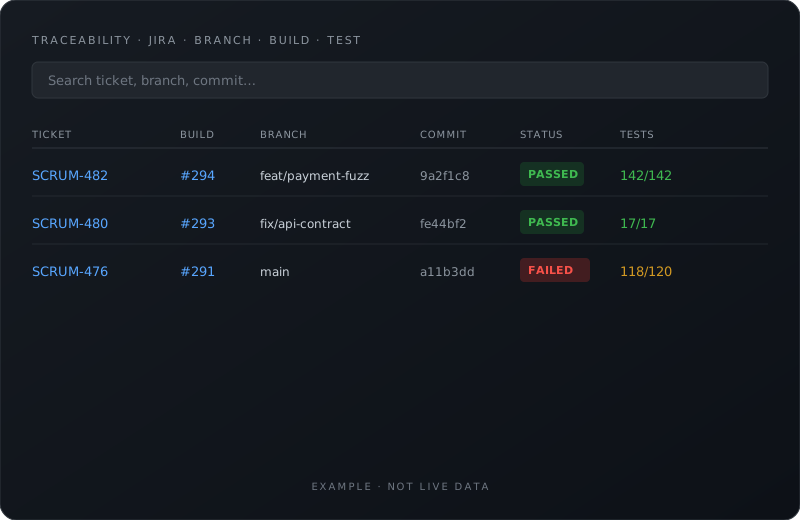
The most expensive test suite is the one nobody reads. Teams invest months building automation, then ship reports into a folder that gets opened only at the next audit. The result: failures get re-discovered, flakes get re-suffered, and leadership has no honest answer to "are we getting better or worse?"
I help teams build a traceability layer that connects every test run back to the commit, PR, requirement, and ticket it belongs to. Reports become searchable. Failures get owners. Trends become visible. The pipeline starts producing decisions, not just logs.
Automation runs, but evidence is scattered across drives, Slack, and ad-hoc spreadsheets — so the same failures resurface and every audit turns into an archaeology sprint.
Centralized, versioned reports tied to commits, PRs, and requirements — with ownership, triage, and trends built in.
Every run is auditable end-to-end. Every failure has a name on it. Every deploy gets a verdict, not a vibe.
30-min intro about test traceability — no slides, just questions about your setup.
What I aim for in every engagement.
Not a guarantee — your starting point determines what's realistic. We'll set concrete targets together in week one.
The target I work toward: push to trustworthy green check on most suites.
Cap I push for on the critical suite — anything above gets quarantined and fixed.
What I aim for: a new engineer running the full suite locally on day one.
Performance & Load Testing
Design realistic load, stress, and soak tests that surface bottlenecks long before they hit production.
Most teams treat performance testing as a one-off before a big release — a manual JMeter run on a laptop, the day before go-live. By the time results come back, it's too late to do anything about them.
I help teams build performance testing into the same engineering workflow as functional tests. Load, stress, and soak scenarios written as code, versioned alongside the application, and executed in CI against representative environments.
Performance issues are discovered in production by real users, not in test by the team.
Code-first load tests with k6 and Gatling, integrated into CI with clear SLOs and trend dashboards.
Predictable performance, fewer incidents, and confidence to ship under load.
30-min intro about performance & load testing — no slides, just questions about your setup.
Everything works — until the one person
who built it goes on vacation.
One engineer holds the whole framework in their head. New hires onboard for weeks before they can write a stable test. The team can run the suite — but extending it, debugging a flake, or wiring a new pipeline still routes back to the same person. That's a hiring problem dressed up as a tooling problem.
QA Training & Workshops
Hands-on workshops that turn manual testers into modern, DevOps-aware automation engineers.

An empowered team capable of owning the entire quality pipeline.
The role of a QA engineer is changing. Clicking through interfaces manually is no longer a viable long-term strategy for scaling teams. Your QA engineers need to learn code, infrastructure, and CI/CD concepts.
I provide hands-on workshops and mentorship to upskill traditional QA testers into modern, DevOps-aware automation engineers. The curriculum is built around your team's existing stack — whatever the language — so the lessons transfer to real PRs the next day.
- 01Assess
Map the team's current skills and the gap to where you want them.
- 02Design
Curriculum tailored to your stack and timelines.
- 03Teach
Workshops + pair sessions on real work, not toy examples.
- 04Embed
Documentation, champions, and follow-ups so it sticks.
30-min intro about qa training & workshops — no slides, just questions about your setup.
Not sure which service fits?
Tell me where it hurts — slow pipeline, flaky tests, no framework, junior team. I'll suggest the shortest path to a fix.
Most engagements start with one service and grow into two or three. They were designed to reinforce each other — a fast pipeline matters less without traceability, and traceability matters less without trustworthy environments underneath.
Book a 30-min callScoped per engagement after a discovery call.
Whichever fits your finance team better.
Based in NL, on-site visits possible.